
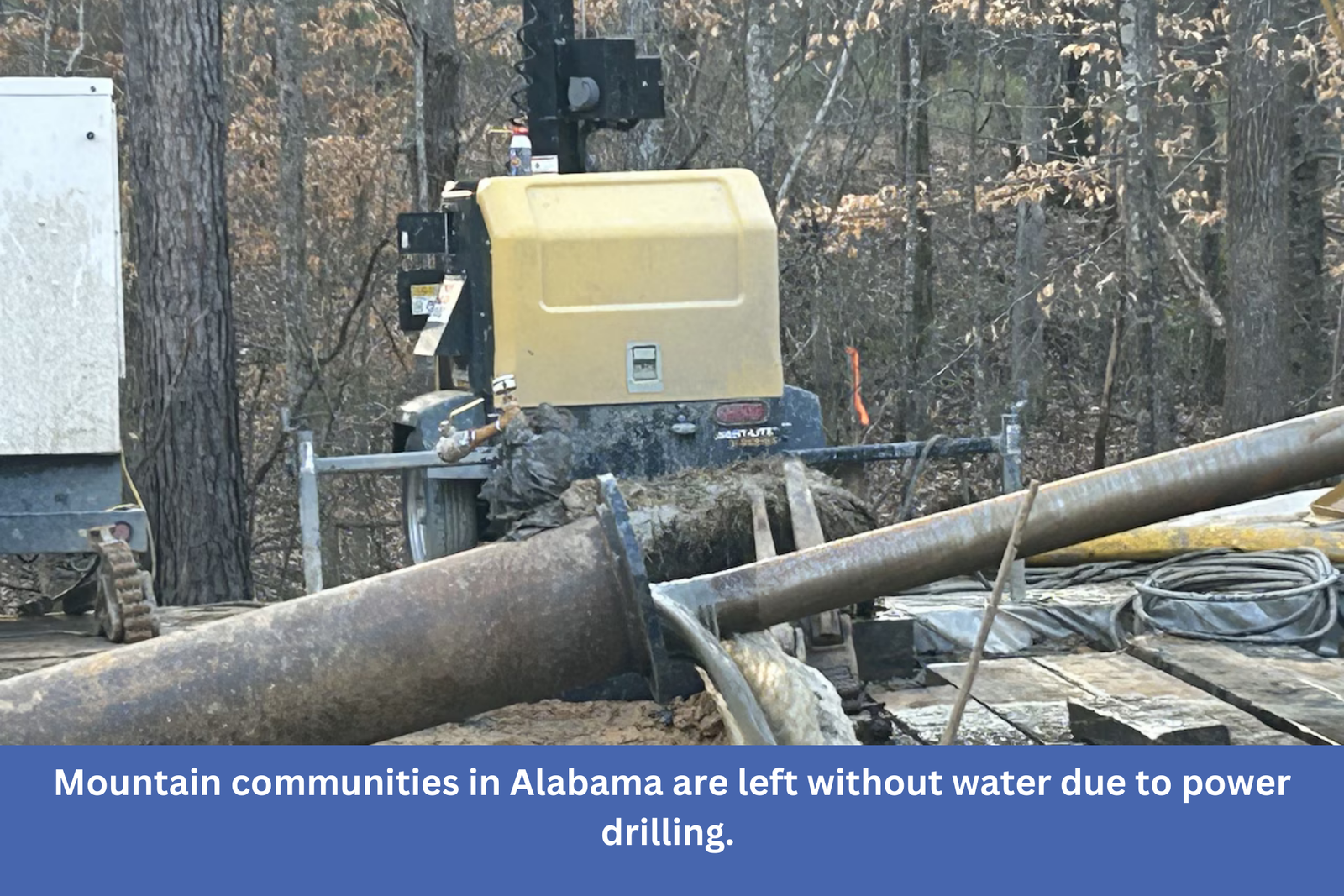
Drilling machinery outside of Vandiver, Alabama, spews water. The drill damaged the aquifer from which the locals’ wells drew, leaving them without water. In order to put fiber cable underground, R.E.M. Directional was hired to execute the drilling on behalf of Alabama Power. (Image by Tommy Fish.)Tommy Fish
After an underground fiber cable installation operation damaged the aquifer that supplies their wells, some residents of Vandiver, a small, hilly village located just east of Birmingham, are currently without water.
Tommy Fish, a resident whose well has been affected, stated, “What scares us all is that they’re not sure it can be fixed.”
Last week, Shelby County residents sued to halt the project, but the judge has mandated that the drilling proceed.
To construct fiber cable on its existing rights-of-way and drill in Coosa Mountain in Shelby County’s northern region, Alabama Power engaged R.E.M. Directional.
The drilling project is “a vital component to enhancing reliability and service to our customers,” Alabama Power spokesman Alyson Tucker told AL.com in an email.
Residents started to discover problems with their wells around three weeks ago, according to Fish, one of the lawsuit’s three plaintiffs. After some days of pondering, Fish and another local visited the drilling location, where he said crew members reported that they had previously encountered a “blowout” and that water had started to flow from the drilling location.
Before this, residents were unaware of the incident, Fish
In an email, Tucker stated, “We discovered about two weeks ago that some residents in the Vandiver area who were served by private water wells were having problems with their water source.” “We have been keeping in close contact with the affected residents and offering support when required.”
Several attempts for comment from a counsel for R.E.M. Directional were not answered.
The water used by Fish and the other community members comes from private wells. The distance prevents them from being connected to a utility’s drinking water supply. Although Fish’s well hasn’t dried up entirely, he added that eight wells owned by five homes are currently totally dry.
Water will continue to flow from the aquifer as long as drilling is done, he said. The aquifer’s continued depletion may have an impact on more residents.
“More people will be impacted as the water table continues to drop,” Fish stated. “It’s expanding.”
Drilling was stopped on Friday when Shelby County Circuit Court Judge Patrick Kennedy issued a temporary restraining order in response to a complaint that Fish and two other locals had filed against R.E.M. Later, Alabama Power became an intervenor in the lawsuit.
But in order to finish the project as soon as possible, Kennedy ordered drilling to commence on Tuesday, 24 hours a day, 7 days a week. Another hearing is scheduled on February 18, and Alabama Power will also be required to provide a daily status report to the judge.
The final drilling might take three days to three weeks, according to Bruce Romeo, an attorney for Fish and the other claimants.
Romeo stated that they would have supported consulting with a hydrogeologist before drilling resumed. The judge decided to permit operations to resume since there was no other option and because that could take weeks or perhaps months.
According to Romeo, Alabama Power and R.E.M. had argued that expediting the project’s completion was the best approach to address the water issue.
Tucker stated, “Alabama Power is working nonstop to finish the project as soon as possible.” “Once finished, we can thoroughly evaluate any affected wells and take swift action to address the issue. Alabama Power will continue to communicate with anyone impacted by this work as part of our ongoing commitment to the affected residents, our customers, and our communities.
However, the long-term consequences for the
Romeo remarked, “We’ll have to see first if they can fix this.” “I have some doubts…We are still very much in the early stages of this.
Furthermore, according to Fish, it goes beyond water: depleting the aquifer can cause the ground to become unstable, endangering people’s homes.
Residents are most afraid of the uncertainty, according to Fish. Their hard-earned properties are under danger because they lack access to water.
“[The provided water] is great for those who haven’t had water, but that’s what worries us looking down the road,” Fish stated. “Will water tanks be around forever?”